Pages

Showing posts with label Mother Nature's Grocery Store. Show all posts

Tuesday, June 4, 2013

Goose Berries are Ready!!!

 It is time to get yourselves out to the edges of the timber and pluck those tart little gooseberries from their thorny branches!  These little berries taste like a very sour apple.  When sugar is added for a pie or jam, an all together new flavor is created, but the tartness still takes the spotlight.  If you are one of those kids who loves sour candies, you are going to love these!
Here are a few tips for picking:
1. Wear good gloves.  Something that the thorns won't poke through too badly, and something that isn't too big or baggy.
2. Wear long pants and long sleeve shirt.  This will protect you from bugs, thorns and poison ivy.
3. Take a bucket or basket that won't let the tiny berries fall through.
4. Take a kid with you.  Kids can get down and reach some of the hard to get places.  Plus, kids love being in nature.  My 9 year old kept tasting berries, saying, "this is so relaxing and peaceful! I love this!"
5. Don't be afraid to move the branches around. This is where those gloves come in really handy.  Pull, lift and move the branches out of the way, picking the top and underside of each branch.  Part the bush so that you can pick the berries on the top and bottom of the bush, the inside and the outside.
6. Once you have picked all of the berries, walk around the bush and re-check it from another direction.  I bet you missed some.
7. The green berries are the ones you want for cooking.  The purple or black berries have over ripened.
~Rebecca

Wednesday, May 1, 2013

It's Morel Mushroom Season!

When the redbuds are in bloom, the mushrooms are popping up...
Every spring I carefully watch all of the redbuds in my area and am ready for hunting as soon as the reddish purple flowers pop out on the scrawny branches.  Of course, timing is not the only important aspect of the mushrooms arrival.  The weather also has to be right.  If the weather is not quite right at the right time, the mushroom harvest will be smaller.  This year seems to be one of those years so far, and the weather to come in the next few days doesn't look promising either.

This year, I am lucky enough to live right on the edge of timber.  Down in the timber is where most folks pick their mushrooms.  However, they really can grow anywhere. Grandma picks them right out of her backyard, in the middle of town, some years.  Growing up, I was always taught to look around the hedge trees and may apples.  I have picked them under many different kinds of trees though, from sycamore to cedar.

Last year, was an exciting year for picking.  Here are a few tips for mushroom hunting:
1. Never pick on land that isn't yours without specific permission!
2. Wear appropriate clothes.
This was an unplanned Easter hunt. My legs were scratched up, my lace blouse was snagged.  I borrowed tennis shoes from my aunt, but even those did not protect me from honey locust thorns.
3. Wear bug spray.  Ticks are out and eager to get you this time of year.
4. Take a bag with you.  We recycle shopping bags.
5. Know what you're hunting for and don't pick it or eat it if you aren't absolutely sure its a morel.
Click Here for a Great Link All About Morel Mushrooms!
6. Be sure to stop and smell the may flowers. And, while you're at it, enjoy the natural beauty of God's handiwork.
7. Really study the ground while you are hunting.  To a novice, those little buggers can really blend in with the land, litter and plants around them.
8. Get some tips on the best places to hunt (if you can find someone who is willing to reveal their secrets) and listen to the buzz in the area about the kinds, amounts and sizes of mushrooms folks are picking.  Here and now, I have heard that folks have been picking the smaller grey morels for a week or two and the larger yellower morels are just popping up on the bluffs and river bottoms.

So far, we have not found a single mushroom in our timber.  Either they haven't popped up or we just aren't very good hunters, or maybe they don't grow there.  Anything is possible.  However, we will keep looking.  It is a great family activity, plus we have found some other great finds, like raspberry and gooseberry patches!

Here is another great link which shows where mushrooms have been reported:
http://morelhunters.com/

9. Soak your harvest in salt water, and cook them up soon, They will get mushy and go bad in just a couple of days, so don't delay enjoying them!

10.  If you have extra, either freeze or dry them to enjoy them later or share them!  There are whole communities of men and women who have lost the ability to hunt their own mushrooms, but still would love a taste one of mother nature's finest delicacies.

Friday, April 26, 2013

Fried Dandelion Blossoms - From Mother Nature's Grocery Store

Did you know that you can eat dandelions?  Did you know that dandelions are good for you?  We use the green in fresh salads and we fry up the blossoms.  Fried dandelion blossoms is something that my grandmother made for us as a special treat.  We loved them and always gobbled them up just as soon as she plucked them out of the oil.  Now, this time of year, my own kids are clamoring for me to fix them fried dandelion blossoms.  If you have never tried them, you should.
Before diving into the recipe, I want to make a special note, Never used dandelions that have been sprayed with pesticide or herbicide or fertilizer (although I don't know anyone who fertilizes dandelions, you can never be too safe).
Here is how you make these special treats:
Ingredients:
2 quarts of cool water
4 cups of dandelion blossoms
1 palm full of salt
3 eggs
1/4 cup of milk
2 cups of flour
Canola oil - enough to submerse the blossoms, the amount will depend upon the size of pan you use

 First, send your kiddos out to pick dandelion blossoms.  Chances are they will pick too many, but in this recipe, you only need about 4 cups.
 Each blossom needs to have the stem completely removed.  Any remaining stem will cause a very bitter blossom.  Just pinch them off.
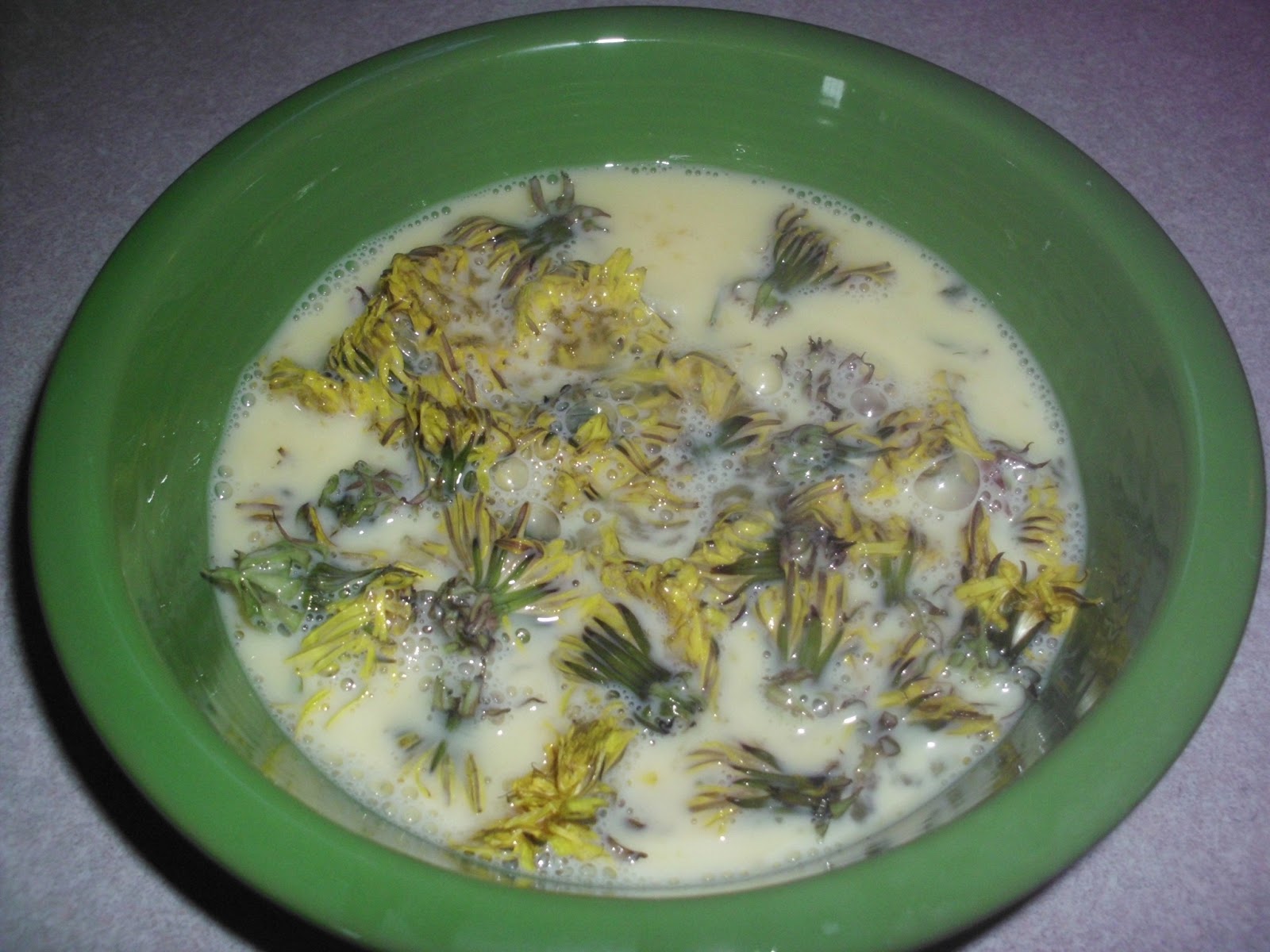
 Toss the blossoms into a large bowl with about 2 quarts of cool water and a handful of salt tossed in.  Give the blossoms a bit of a swish with your hand to knock off any dirt and bugs.  Soak the blossoms for at least 1 hour, but not more than 2.  This is going to completely remove any bugs from deep inside the flower and kill them.
 Scoop the blossoms out of the bowl, leaving the dirt in the bottom and move the blossoms over to a strainer and give them a good rinse.  Shake out as much excess moisture as possible and leave them to strain while you prepare your breading and egg wash.  You should also preheat your canola oil.  I fry mine up on medium heat.
 In one bowl whisk together 3 eggs and 1/4 cup of milk.  In another bowl, measure out about 2 cups of flour.
 Toss a handful of blossoms into the egg wash.
 Then, dredge in the flour, shaking off excess flour.
 Carefully place the blossoms into the hot oil and allow them to fry until the bottom side is golden brown.
 Flip the blossoms with a slotted spoon and remove when the entire blossom is golden brown.
 With a slotted spoon, remove from the hot oil and place on a plate with a dry paper towel.  Allow the paper towel to soak up the excess oil.  Lightly salt, to taste, each batch as soon as it is placed on the towel.
Dandelions are best served up with your favorite summertime sandwich and fruit!

Monday, April 22, 2013

Mother Nature's Grocery Store - Spoonbill Fish

An abundance of delicious foods can be easily found growing wild and free for the taking right in your back yard, out in the country or even on conservation land, where prohibited.
All you need to know is where to find such wonderful delicacies and how to prepare them.  If you need to harvest from land other than your own, you will need permission from the landowner, or contact the Missouri Department of Conservation for the rules and regulations on harvesting from conversation land.
Some of the bounty I regularly enjoy from Mother Nature's Grocery Store are fish, deer, morrel mushrooms, dandelion blossoms, black berries, gooseberries, mulberries and walnuts.  I know that in Northwest Missouri, there is much more available and I am excited to seek out and harvest a larger variety of foods.  Beyond the native animals that are available to hunt, or even at the grocery store, there are many produce items that you can easily pick.  Persimmons, elderberry and violets are something I would love to try.
This weekend, my family and I spent the weekend taking part in the annual spoonbill season.  Spoonbill, also known as paddlefish, have a harvesting season from March 15 thru April 30 in Missouri.  Harvesting spoonbill is done by snagging them with are large snagging rod and reel set-up  along with a couple of large treble hooks and 14 - 16 ounce sinkers.  Essentially your hooks and lines rake the river bottom and by chance you hook a nice size spoonbill.  We usually snag in Warsaw on the Osage River.  The size requirements there are 34 inches from the eye of the spoonbill to the fork in the tail.  This weekend, we were lucky enough to snag this 70 pound female.  My husband did an excellent job bringing her in!  Here is more information about snagging for spoonbill in Missouri.
Click here for the Missouri Paddlefish Snagging Report
The Spoonbill is a very interesting fish because of it's unusual anatomy.  It has a large bill extending from the front of the fish.  Spoonbill have a slick skin rather than scales and they do not have a single bone in their bodies.  When cleaning a spoonbill, you must remove the fat and the red meat from the white meat.  The white meat is the meat you want to eat.  I know of two ways to clean a spoonbill.  First, if you have a female, you are require by law to remove the eggs at the body of water you caught the fish in and dispose of them there.  They will be recycled back into nature.  The eggs are protected from harvesting due to poachers illegally harvesting female spoonbill.  The innards should be removed.  Then, you may either fillet the meat from both sides of the fish's body or you can remove the head and tail, then carve the meat into steaks.  After removing the meat from the body, remove the skin, fat and red meat from the white meat.  Here is a youtube video that shows someone else's method, which is also very simple.  Warning: this video contains blood and guts!
Click Here to see how to clean a spoonbill
I personally prefer to bread my spoonbill in a cornmeal breading and fry it in canola oil, but there are many ways spoonbill can be prepared.  Spoonbill is a light white meat that more resembles chicken than fish.  When the meat is properly cleaned of fat and red meat, there is very little or no fishy taste.  It is one of the few fish my husband enjoys eating because of it's light flavor.

Click Here for Fried Spoonbill Recipe

Click Here for Baked Spoonbill Recipe

It's not too late, you still have 1 week left to catch your own spoonbill!  Water temperature and flow is perfect for harvest on the Osage River right now!  On April 27th the Old Oar House on the Osage River is holding a spoonbill tournament.  You could walk away with not only a prize fish, but a tournament prize as well!
~ Rebecca